





Hardware Finishes: PVD and Powder Coating
PVD and powder coating are the two coating technologies most often specified when a project needs a hardware finish that combines colour or metal-tone variety with the kind of durability that a raw metal can't deliver on its own. Both are used to protect a substrate (usually steel, aluminum, or brass) and to give it a controlled appearance. Both are durable enough for high-traffic residential and commercial work. They differ meaningfully in how they're applied, what they look like, and how long they last. This guide explains both — when to specify each, how they're made, and how to care for them. Part One covers everyday metal finishes (brass, bronze, chrome, nickel, stainless), Part Two covers living finishes (raw, unsealed metals that patina by design).
What is powder coating?

Powder coating is a finishing process in which dry polymer-resin powder is applied to a metal substrate using an electrostatic charge, then baked in an oven so the powder melts, cures, and bonds into a smooth, hard, durable surface. The result is a finish that's tougher than paint, resists corrosion and chipping, comes in essentially unlimited colours, and lasts twenty years or more under normal use.
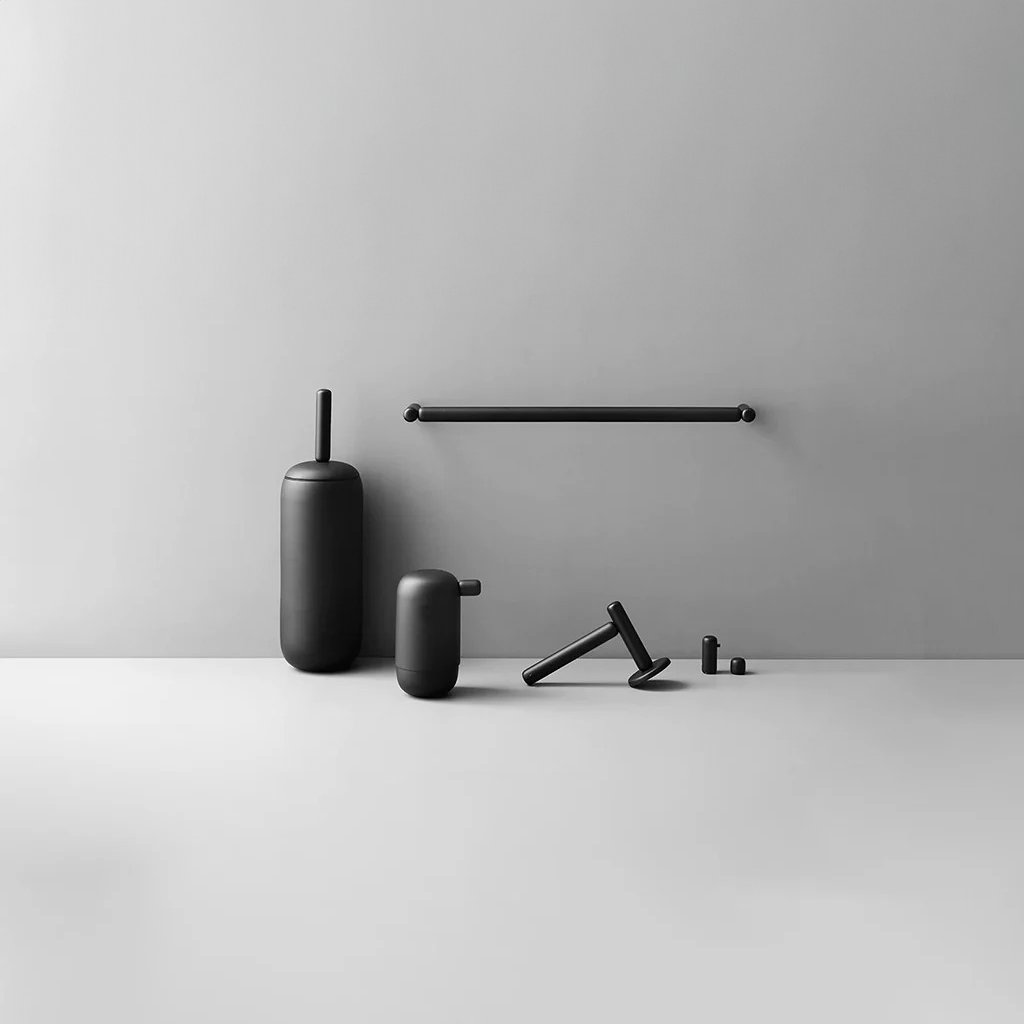
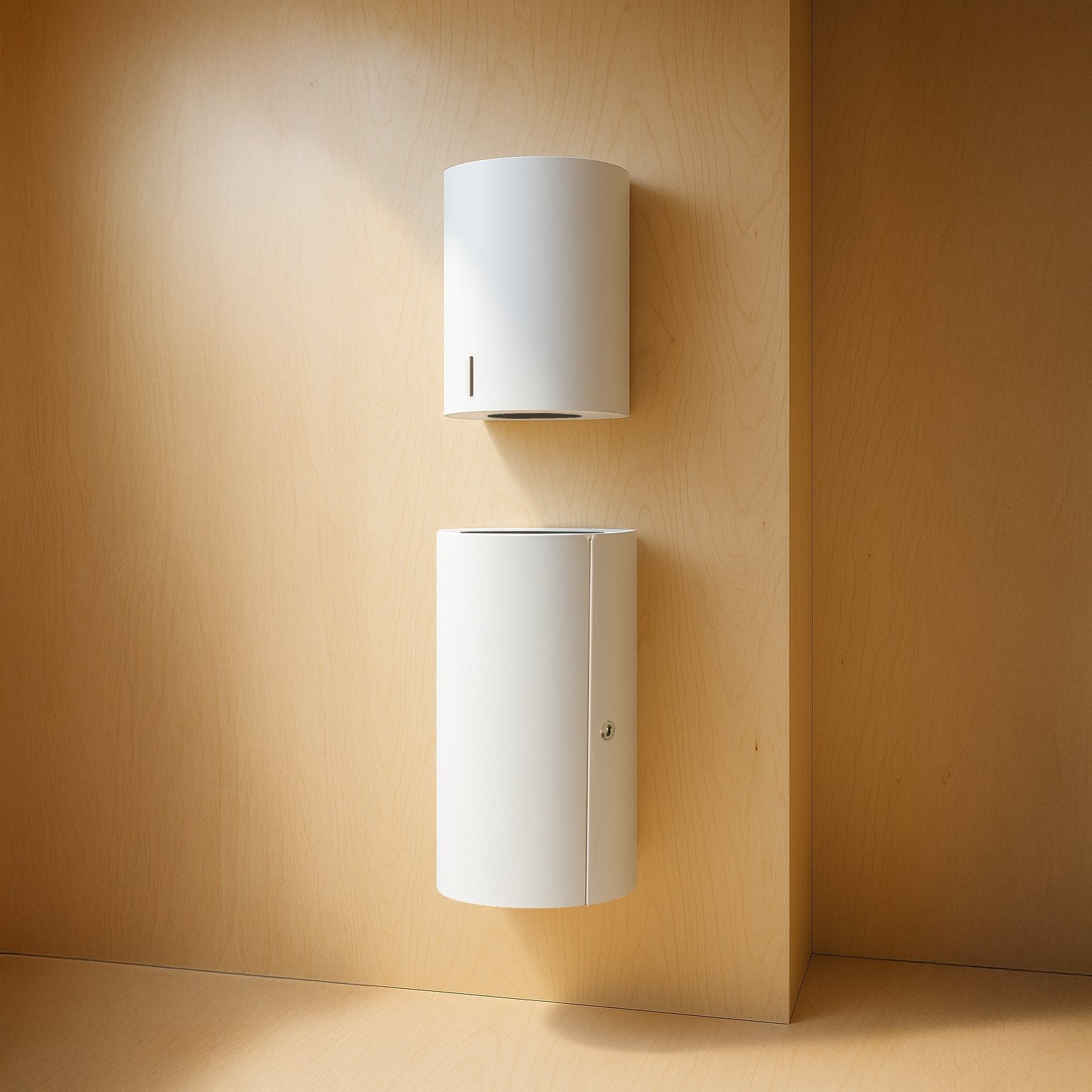
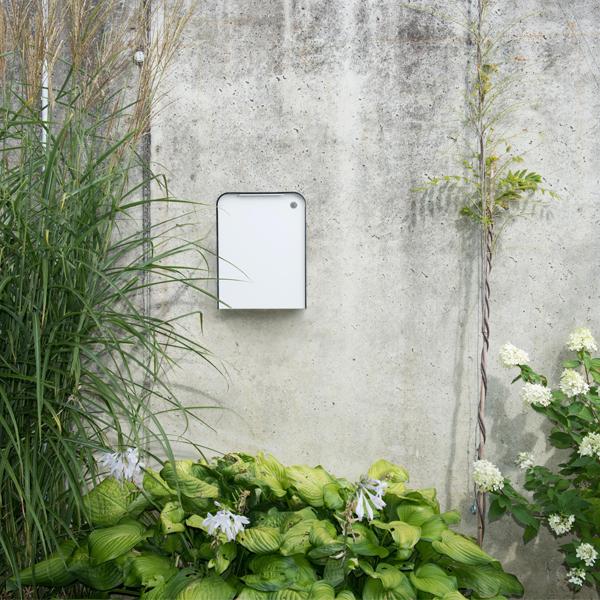
Because powder coating is a polymer rather than a metal, it cannot replicate true metal finishes — a powder-coated surface looks like coloured plastic at close range, even when it's an excellent powder coat. Where powder coating excels is in colour. Available across the full RAL Classic palette in matte, satin, eggshell, or gloss, powder coating is how Casson supplies most of its commercial bathware in saturated colours — the BJÖRK, LOKI, and Stainless Design lines from Dan Dryer are powder-coated to whatever RAL colour the project specifies.
What is PVD coating?
PVD — Physical Vapor Deposition — is a vacuum-chamber process in which a thin layer of metal is vaporized and deposited atom-by-atom onto a substrate. The result is a true metal coating, fused at the molecular level to the underlying material, that's harder, more corrosion-resistant, and more wear-resistant than the substrate beneath it. PVD coatings can extend the functional life of a piece of hardware by up to ten times — a properly applied PVD finish on a tap, lever, or pull will routinely last twenty-five years or more.
The process happens entirely in a high-vacuum chamber: the substrate is mounted as the cathode, the source metal is vaporized as the anode, and the vaporized metal travels across the vacuum and bonds to the substrate's surface. Because the bond is molecular rather than mechanical (as paint or even powder coat are), PVD finishes can't peel or flake. Because the process is dry and produces no chemical reagents or harmful by-products, PVD is one of the more environmentally favourable coating technologies available.
What's the difference between PVD and powder coating?
Both finish and protect a metal substrate. The differences come down to four practical considerations.
How they're applied. Powder coating is electrostatically sprayed dry powder, then heat-cured. PVD is metal vapor deposited in a vacuum chamber. Powder coating is the simpler and faster process, which is part of why it costs less per piece.
How they look. Powder coating produces a polymer surface — it can be any colour or sheen, but it always reads as coloured material rather than as metal. PVD produces a true metal surface — it can mimic the appearance of brushed stainless, gold, bronze, gunmetal, polished copper, or matte black, and reads as the metal it's imitating because chemically it is that metal. Powder coating is the choice when colour is the design intent; PVD is the choice when a metal-look-and-feel finish is needed.
How long they last. Both are durable enough for high-traffic use. PVD is significantly more durable — it's roughly four times harder than chrome, resists scratching and impact better than powder coating, and doesn't fade or discolour over time. Powder coating can fade over decades of UV exposure (more pronounced on outdoor applications), and chips or scratches if struck hard enough.
What happens when they're damaged. Powder coating can be repaired or completely re-applied if it scratches, fades, or chips — a damaged piece can be stripped and re-coated as good as new. PVD generally cannot be repaired in place. The trade-off is that PVD damage is rare to begin with (the coating is genuinely hard to scratch), but when it does happen, the only fix is re-application by the manufacturer or replacement.
Why specify PVD over uncoated stainless steel?
Three reasons. First, durability — PVD is harder than the underlying stainless and adds meaningful scratch and wear resistance, which matters for high-traffic commercial fittings (door levers, taps, handles). Second, finish variety — uncoated stainless comes in polished or brushed; PVD can be specified as gold, bronze, gunmetal, satin black, polished copper, or any of several other colour-of-metal options that uncoated stainless can't produce. Third, longevity — PVD's bond is molecular, and the finish stays bright and stable across decades of use, where uncoated polished stainless can dull or develop water-spot patterning over time.
The most common PVD specification we see is on commercial bathware and door hardware where the project wants a non-standard metal tone (warm bronze, satin gold, deep black) without the lifecycle compromise of softer materials like brass or solid bronze. The Qtoo single-hole kitchen faucet and d line's Knud lever are both available with PVD options for exactly this purpose.
What colours does PVD coating come in?
PVD has a more limited palette than powder coating because it has to use a real metal as the source. The standard PVD colour range available across the architectural hardware industry includes: PVD satin stainless, PVD satin black, PVD gunmetal, PVD satin gold, PVD bronze, and PVD polished copper. Some manufacturers offer additional variants — rose gold, champagne, antique brass — depending on the source metals available in their facility.
For projects that need a specific colour outside the PVD palette, powder coating is usually the right answer. A project specifying "matte teal" or "powder pink" is almost certainly looking at powder coating; a project specifying "warm bronze that won't tarnish" or "satin gold for a commercial bathroom" is almost certainly looking at PVD.
How do I care for powder-coated hardware?
Powder coating is highly resistant to corrosion, weathering, and everyday handling, but the polymer surface can be damaged by harsh chemicals. The care routine is simple:
For routine cleaning, wipe with a dry soft cloth. For more thorough cleaning, mild soap diluted in warm water on a soft cloth or sponge, then rinse with clean water and pat dry. Avoid acetone, paint thinner, abrasive cleaners, and any solvent stronger than basic dish soap — chemical solvents can soften, strip, or discolour the polymer coating even when the cleaning seems gentle.
If powder-coated metal loses its sheen over years of use, a thin layer of automotive-grade paste wax applied like car wax (apply, let dry, buff off) can restore some of the original lustre on glossy finishes. Test in an inconspicuous area first; this is not appropriate for matte powder coats. If the coating itself is chipped, scratched, or wearing through, the only proper fix is professional repair or full re-application — household paint will not adhere to powder coating.
How do I care for PVD-coated hardware?
PVD is the most maintenance-free of the architectural finishes. For routine cleaning, wipe with a soft cotton or microfibre cloth — that's the entire requirement under normal indoor use.
What to avoid: abrasive scrubbers, steel wool, scouring pads, polish compounds, and chloride-based cleaners. PVD is harder than chrome but not invulnerable; abrasives can mark the surface, and chlorides (bleach, some bathroom cleaners) can pit certain PVD chemistries over time. Avoid strongly acidic cleaners (vinegar, descalers) on PVD bathware, which can etch the surface dulling on water-spotted areas.
One frequent confusion: cheap fashion watches and consumer electronics sometimes describe their finish as "PVD" when it's actually a thin decorative film that wears off with use. Real architectural PVD — the kind specified through Casson — is a properly deposited metal layer and will not wear off under normal use. When PVD is correctly applied to architectural-grade thickness on a substrate appropriate for the application, it lasts essentially the lifetime of the piece.
Which should I specify for my project?
Powder coating when colour is the design intent — saturated tones, matte finishes, custom RAL specifications, projects that want hardware to match a brand palette or coordinate across non-metal elements. Most cost-effective for commercial colour systems.
PVD when a non-standard metal tone is the design intent — warm bronze, satin gold, gunmetal, satin black — and the project values longevity over repairability. Most appropriate for high-traffic door hardware, taps, and pulls in environments where the finish needs to look the same in twenty years as it does on installation day.
Both are durable enough for any reasonable residential or commercial application. The choice between them is design intent and budget, not quality.
For more on the underlying materials these coatings sit on — particularly stainless steel grades, the chromium oxide passive layer, and where each finish belongs — see The Story of Stainless Steel. For raw metals that age by design rather than coating to prevent change, see Part Two: Living Finishes.
Leave a comment