





Pendant Lights: How to Choose, Where to Use, and What Height to Install
Pendant lights do disproportionate work in a designed space. They bring light from the ceiling down to where people actually use it — over a kitchen island, above a reading chair, alongside a sofa, in a stairwell — and they're one of the few fixtures that can function as both task lighting and ambient drama, depending on bulb choice and dimmer settings. This guide covers the practical questions that come up when specifying pendants — what they are, where they belong, what height to install them at, how many you need, and how to handle slanted or vaulted ceilings.

"Design is defined by light and shade. Appropriate lighting is enormously important."
What is a pendant light, and how does it differ from a chandelier?
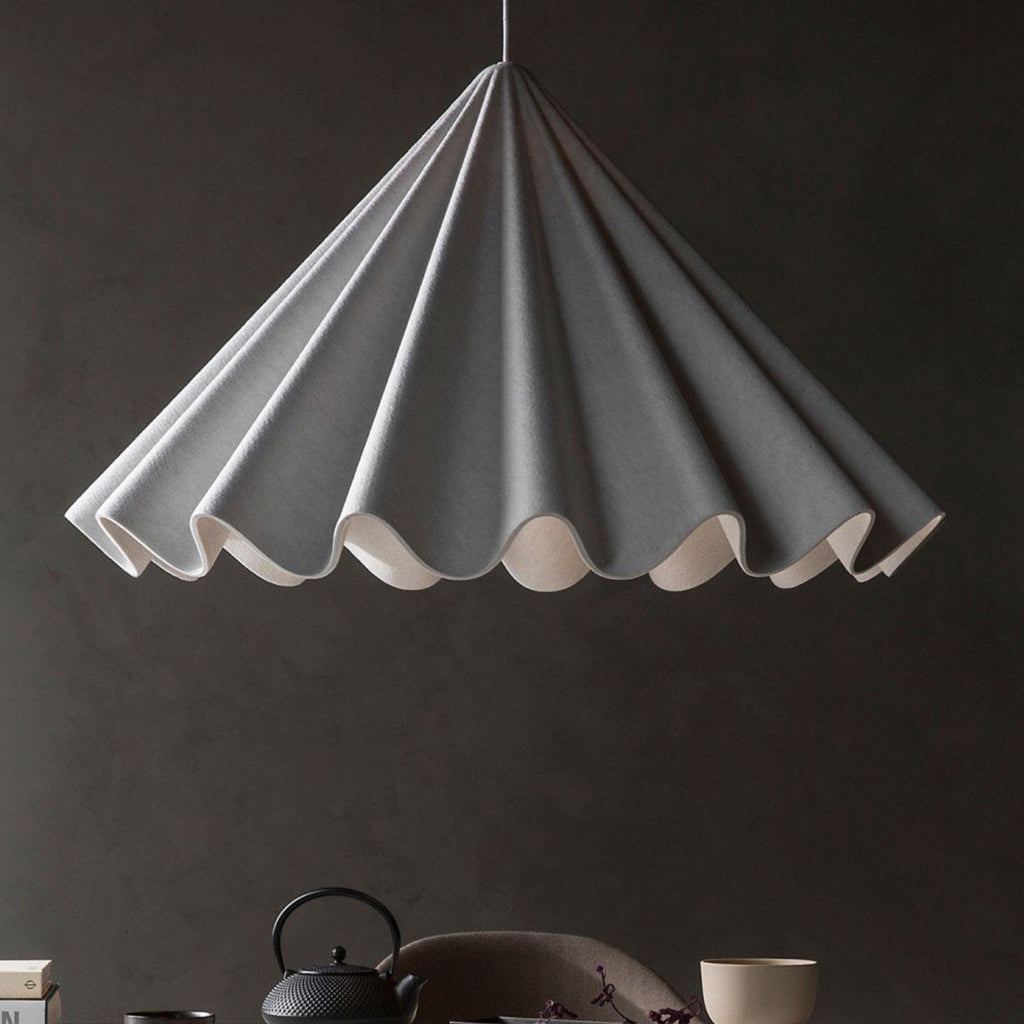
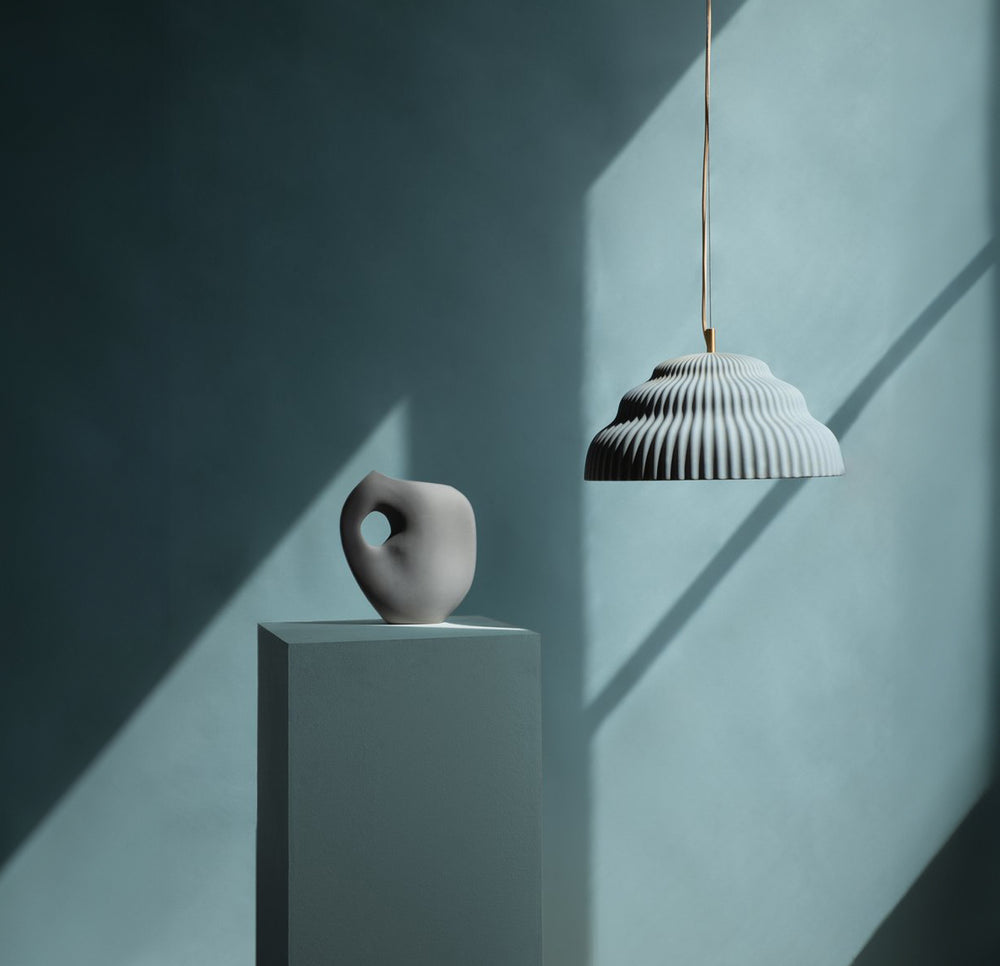
The terms get used loosely — "pendant" often means *modern and minimal*, "chandelier" often means *fussy or ornate* — but both have specific definitions worth getting right. A pendant light is a single light fixture suspended from the ceiling by one cord, chain, or rod. A chandelier has multiple branches and multiple light sources radiating from a central body. The distinction matters because the two fixtures behave differently in a room: a chandelier's distributed bulbs spread softer ambient light across a wider area, while a pendant concentrates more focused light over a defined zone, making it the better choice for task lighting over a kitchen island, dining table, or reading chair.
Some fixtures blur the line — a multi-cord pendant cluster reads visually as a chandelier but is mechanically a group of pendants. The functional question is whether the fixture lights one zone (pendant work) or a broader area (chandelier work). The aesthetic question is whether you want the visual mass of a chandelier or the lighter touch of a single suspended object.
Why use a pendant instead of a chandelier?
Three reasons specifiers reach for pendants over chandeliers. First, focus — pendants concentrate light where it's needed, which is why they dominate kitchen island lighting, dining tables, and reading nooks. A chandelier in those positions illuminates the whole room but can leave the working surface itself underlit. Second, scale flexibility — a single pendant suits a small room or a tight zone where a chandelier would feel oversized. Third, visual restraint — pendants read as architectural details rather than decorative statements, which suits projects working in a more minimal language.
Pendants also work in places people don't typically expect them. Try a single pendant in place of a wall sconce — flanking a bed, beside a sofa, or asymmetrically over an occasional chair. Two matched pendants either side of a bed read as a more current alternative to bedside lamps; one pendant offset to the side of a sofa reads as deliberate eclecticism rather than an oversight. The technique works because pendants are inherently sculptural; they earn the visual weight that a sconce or table lamp would need additional decorative treatment to achieve.
Where should I put pendant lights in my home?
Pendants belong wherever overhead light needs to come closer to the working surface. The four positions where they earn their keep:
Over kitchen islands and counters. The default and best-known pendant position — bringing task lighting down to within reasonable distance of the cooking surface, often grouped in clusters of two or three for an island, or a single oversized pendant for a smaller counter.
Over dining tables. A single large pendant or a group of three smaller ones, hung at a height that lights the table without obstructing across-table conversation. Always specify on a dimmer — bright pendants for homework, dim pendants for dinner parties, all from the same fixture.
In foyers, hallways, and stairwells. Tall vertical spaces (entryways with double-height ceilings, stairwells, vaulted hallways) reward pendants because the cord length itself becomes part of the design — a single dramatic pendant at depth, or a cluster of pendants at varied heights, fills vertical space that a flush-mount or chandelier can't.
As wall-light substitutes. Beside a bed, alongside a sofa, over a side table, beside a reading chair — pendants used as sconce or lamp replacements add architectural weight to spaces that would otherwise rely on traditional plug-in lighting. Particularly useful when the side-table real estate is precious and a free-standing lamp gets in the way.
What height should pendant lights be installed at?
Two distinct rules apply, depending on whether the pendant hangs over a walking area or over a surface.
Over walking areas: hang pendants a minimum of seven feet (2.1 metres) from the floor — roughly 12 inches down from a standard 8-foot ceiling. For taller ceilings, add approximately 3 inches of cord per additional foot of ceiling height: a 10-foot ceiling gets a 30-inch cord, an 11-foot ceiling gets a 33-inch cord. The principle is that nobody should ever bump into the fixture, and the visual proportion stays right as the ceiling rises.
Over surfaces (kitchen islands, dining tables, bars, desks): hang the bottom of the fixture 30–36 inches above the surface. Specify 30 inches for ceilings under 8 feet, 36 inches for ceilings of 9 feet or more. The pendant should illuminate the surface clearly without sitting in anyone's sightline across the table or counter.
Sightline tip: aim for a fixture height roughly 6 inches above the head of the shortest person who'll regularly use the space. A pendant that puts its bulb directly in a child's or shorter adult's eyeline is functionally a problem — they'll be looking up into a glare every time they sit down. Lower the pendant or specify a fixture with a diffused light source (frosted glass, fabric shade, or a downward-facing reflector).
How many pendant lights should I use in one space?
Depends on the zone being lit and the fixture's individual scale. Two practical formulas:
Over an island or bar: two to three pendants for an island under 8 feet, three to five for an island 8–12 feet long. Space them evenly along the island's length, with the outermost pendants set in roughly 12–18 inches from the island ends. Pendants too close together cluster visually; pendants too far apart leave dark zones at the counter ends.
Over a dining table: one pendant for round or square tables under 5 feet across, one to three pendants for rectangular tables, scaled to the table's length. A single oversized pendant centred above the table often reads stronger than a cluster, particularly in minimal spaces.
In a foyer or stairwell: one dramatic pendant at the appropriate scale for the space, or a cluster of varied-length pendants suspended at staggered heights. Three or five (odd numbers) usually read better in a vertical cluster than two or four.
For a deeper room-by-room breakdown including ceiling-mount alternatives, sconce coordination, and lighting layering principles, see our guide to designing your space with ceiling light fixtures.
How do I choose a pendant light for my space?
Scale is the primary consideration — too large or too small for the room will feel off in ways that nothing else compensates for. The general rule of thumb: add the room's length and width in feet, and use that sum (in inches) as the rough diameter of a single pendant, or distribute that diameter across multiple smaller fixtures. A 12 × 14-foot room suggests roughly 26 inches of total pendant width, which could be one 26-inch fixture, three 9-inch pendants, or a cluster covering similar visual mass.
The corollary: if you're breaking the rules, commit. Pendants work in extremes — slightly off-centre or marginally oversized reads as a mistake; defiantly asymmetrical or unmistakably oversized reads as intentional. The middle ground rarely succeeds. Designers who break scale rules usually do it dramatically — a single 36-inch pendant in a small bathroom, a cluster of tiny pendants in an enormous foyer — and the result lands precisely because it's deliberate.
How do I install pendants on slanted or vaulted ceilings?
Three categories, with progressively more involvement required.
Corded pendants — the simplest case. A pendant hung from a flexible cord adapts to any ceiling angle on its own, because gravity pulls the fixture straight down regardless of how the mount is angled. Most pendant lights at Casson fall in this category. Cord length is also easily adjustable — most can be trimmed by an electrician to the exact length the ceiling height demands. For a slanted-ceiling kitchen island or dining room, a corded pendant is often the only adjustment needed.
Rodded pendants — slanted-ceiling adapter required. Pendants suspended on a stiff metal rod (rather than a flexible cord) are designed to hang straight down from a flat ceiling. On a slanted ceiling they hang at the same angle as the slope unless adjusted. Most quality rodded pendants offer an optional slanted-ceiling mount that pivots the rod back to vertical — specify this at order. For non-standard ceiling angles, a custom slanted mount can usually be sourced through your contractor.
Multi-branched fixtures — expert installation. Chandeliers, multi-pendant arrays, and fixtures like Anony's Highwire or Schneid's Phase chandelier require careful balance and proportion across multiple suspension points. On a slanted ceiling, this means the mount needs to compensate for the angle while preserving the fixture's intended geometry — work that requires both an experienced electrician and, ideally, the manufacturer's input on the specific installation. For made-to-order multi-branched fixtures, send the full ceiling measurements at the time of order so the mount can be designed for the space.
Browse the full ceiling lighting collection for pendants, chandeliers, and flush-mount options. For the next article in the series — covering room-by-room lighting strategy and how pendants coordinate with sconces, recessed lights, and table lamps — see our guide to ceiling light fixtures. For more on the Canadian designers behind some of our strongest pendant work (Anony, Object/Interface, Schneid), see Canadian Design at Casson.
Leave a comment