






Door Hardware: A Buyer's Guide to Function, Fit, and Ordering
Ordering door hardware goes wrong in predictable ways: a lever that will not fit a pre-bored door, a mortise lock specified for a door that is already hanging, a backwards latch on a handed door. Almost all of it traces back to five things about the door itself, decided before you choose the handle. This guide covers them in the order you actually work through them: function, whether the door is pre-drilled or new, the mechanism, the backset, and the handing. Get those right and the hardware fits and works the first time.
What do I need to know before I order door hardware?

Choosing a lever or knob you love is the starting point, but five details about the door decide whether it fits and functions: the door's function, whether it is pre-drilled or new, which mechanism it takes, its backset, and its handing.
If you know all five, send them to the specification team and we will confirm a set. If you are not sure, the sections below work through each one, and you can send what you have. None of it is complicated once you know what to look for, and most of it you can measure or check in a few minutes with the door in front of you.
Five details about the door decide whether the hardware fits and functions.
What is the difference between passage, privacy, entry, and dummy door hardware?
Function describes how, or whether, a door locks, and it is the first thing to get right when you order.
Passage hardware latches the door closed but does not lock. It suits hallways, closets, pantries, and the active leaf of a pair of doors.
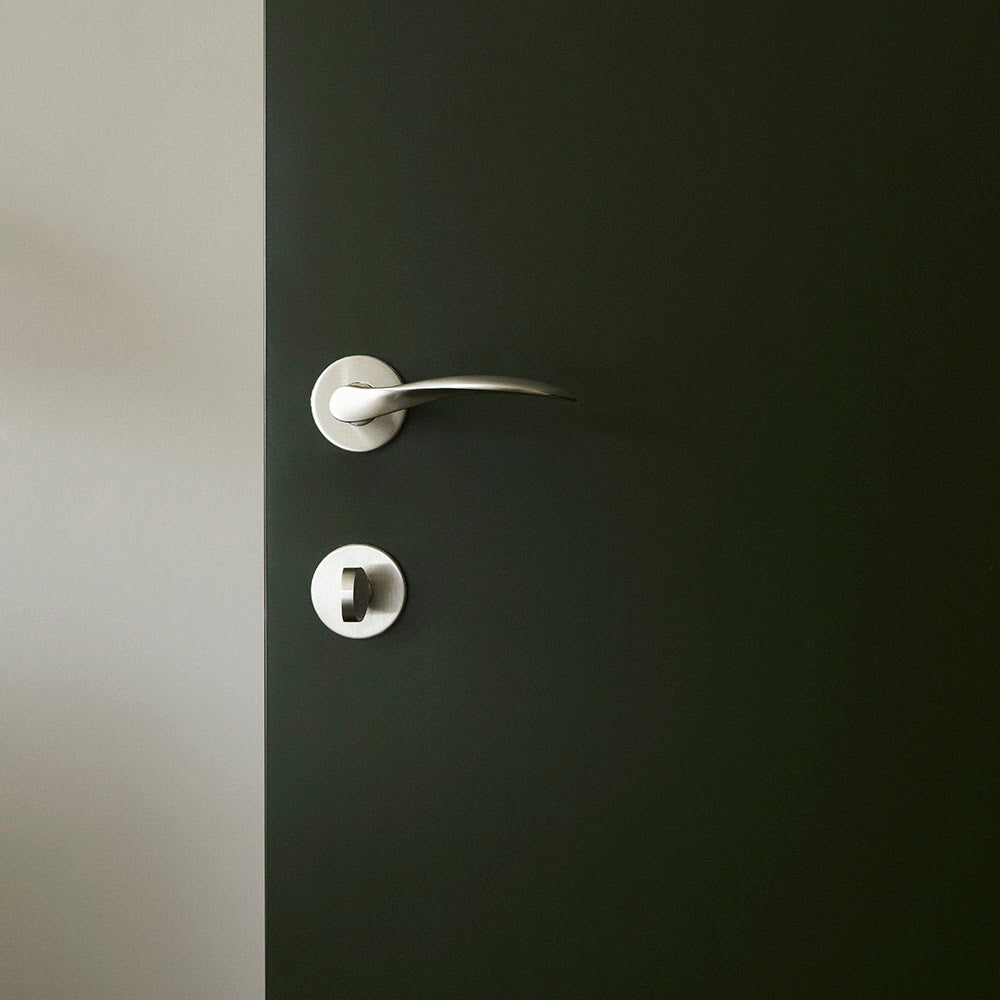
Privacy hardware locks from the inside with a thumb-turn or push-button and has an emergency release on the outside, for bedrooms and bathrooms. A privacy set usually means adding a thumb turn.
Entry (keyed) hardware locks with a key, usually through a euro-profile cylinder, for main and exterior doors. A keyed set adds a key cylinder and, on many models, two escutcheons.
Dummy hardware is fixed with no latch, purely tactile, for closet fronts and the inactive leaf of a double door. It comes single or double, and a dummy order includes a rigidizer and spindle to hold the handle steady.
Every door product page lists the functions available for that model.

Does it matter whether my door is pre-drilled or new?

Yes, more than any other single factor, because it decides which mechanisms and which sizes are open to you.
A pre-drilled or existing door (a retrofit) already has its bore set to a North American standard. That limits your options and can require a larger rose, the plate around the lever, to cover the existing hole. For pre-bored doors we point you to AHI, which is sized to North American standards. Send the bore diameter and backset and we confirm fit. One hard limit follows from this: a euro mortise cannot be retrofitted into a pre-drilled door, and because keyed entry sets are euro-mortise only, we cannot outfit a pre-drilled keyed door.
A new door with no holes gives you the most flexibility. The lever or knob can take any rose or backplate, or none, and you can use a euro mortise, which is our preferred mechanism. The one thing to plan for is that a euro mortise has to be machined into the door before it is hung, so it is a decision you make while the door is still off its hinges, not an upgrade to a door already installed.
A euro mortise cannot be retrofitted into a pre-drilled door, and keyed entry is euro-mortise only.
Tubular latch or euro mortise: which mechanism do I need?

The mechanism is how the latch and lock sit inside the door, and there are two.
A tubular latch keeps its latch bolt and any deadbolt in separate bores. It suits retrofits and pre-bored doors, because it drops into standard North American holes. Passage and privacy doors can both use one, with a privacy door adding a mortise bolt for the lock.
A euro mortise encases both bolts in a steel case that fits a single machined pocket. It is our preferred mechanism: one integrated kit, which makes it sturdier, cleaner, and better suited to the heavier levers from Formani, d line, and Maison Vervloet. Because it has to be cut into the door before hanging, it is a new-door choice, and it is the only mechanism we offer for keyed entry. With a euro mortise you also choose the strike plate shape.
Which backset do I need: 2⅜", 2¾", or 60 mm?

The backset is the distance from the edge of the door to the centre of the bore hole. To find it, measure from the front edge of the door to the centre of the existing hole, or the centre of the latch you are replacing.
North American, tubular: the two standard sizes are 2⅜" and 2¾". For a new door, decide which you will use and send it along. For a pre-bored door, measure. If the backset is neither of the two standards, let us know, and we will source and customize the hardware to keep the door working.
Euro mortise: the backset is 60 mm.
How do I determine my door's handing?
Handing is the direction the door swings. Some hardware is reversible on site and needs no handing specified, but some sprung or keyed sets are handed, and it is worth the two minutes to get it right, because the wrong call means a backwards lever or lock.
Stand on the outside of the door, the side you enter from or would need a key to open. The hinges tell you the rest: if the hinges are on the left, it is a left-handed door; if the hinges are on the right, it is a right-handed door.

Will European door hardware fit a standard North American door?
In most cases, yes, with attention to a few details. European sets are built for a euro-profile cylinder and a metric spindle, and are specified across a range of door thicknesses, so standard North American interior (1⅜") and exterior (1¾") doors sit within range, and fixings are supplied to suit. The two things to watch are the bore, since a pre-bored North American hole may need a larger rose or point you to AHI, and the mechanism, since a euro mortise is a new-door choice. For a retrofit, send your backset and door thickness and we will confirm before you order.
What should I send with my order?
Three measurements cover most orders: door thickness (measure the door edge), backset (the edge to the centre of the bore), and the bore diameter if the door is already drilled. With those, plus the function and the handing, we can confirm a set that fits and functions. You can plan the whole order on the PDF order form or the Excel hardware schedule, or send the details to the specification team.
How do I care for unlacquered (living) brass?
Many of our levers are available in living, or unlacquered, brass, which is left raw so it develops a patina, warming and deepening with handling and time and staying brightest where it is touched most. If you are drawn to that, leave it to age. To hold it closer to its original tone, wipe it occasionally with a soft cloth and a brass cleaner suited to unlacquered finishes. Lacquered finishes are sealed to stay as delivered and need only dusting. Each product page notes the finish you are selecting, and our guide to living finishes covers how they age in more depth.
Where to start
If you know your five details, browse the door hardware collection, choose your lever or knob, and check the functions and finishes on the product page. If you are retrofitting, or working with a pre-bored or keyed door, send your measurements first and we will confirm the mechanism and fit before you order. Registered architects, designers, and builders can also access trade pricing and whole-project specification support through the Trade Program.

Leave a comment