







Barn Door Hardware: A Buyer's Guide to Mounts, Sizing, and Double-Door Systems
Most barn door problems are decided before the hardware is chosen. Get the door width, the track length, and the mount type right, and installation is straightforward. Get them wrong, and the door binds, gaps, or fails to clear the opening. This guide walks through the decisions in the order you actually make them, so the hardware you order fits the door and the wall you have.

What is the difference between face-mount and top-mount barn door hardware?
It comes down to how the hangers attach to the door, and that single choice sets how the finished door reads.
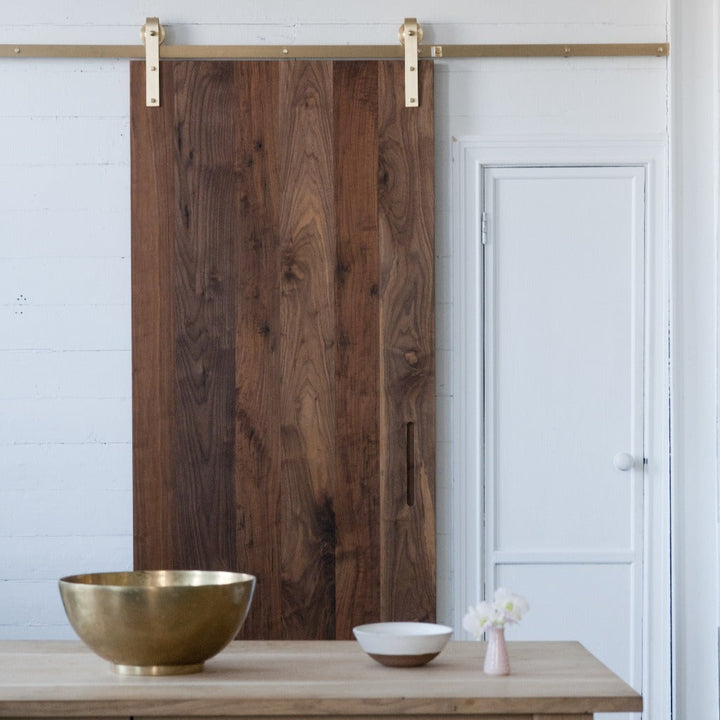
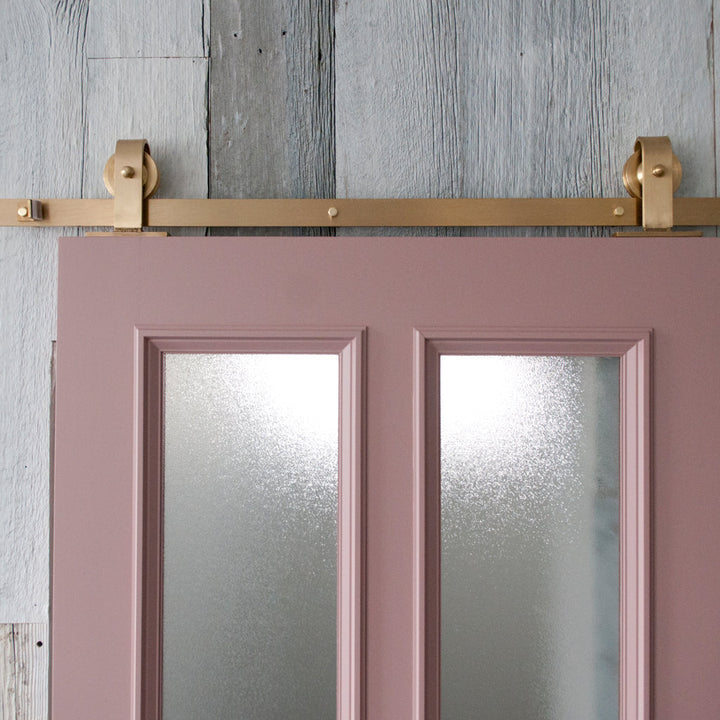
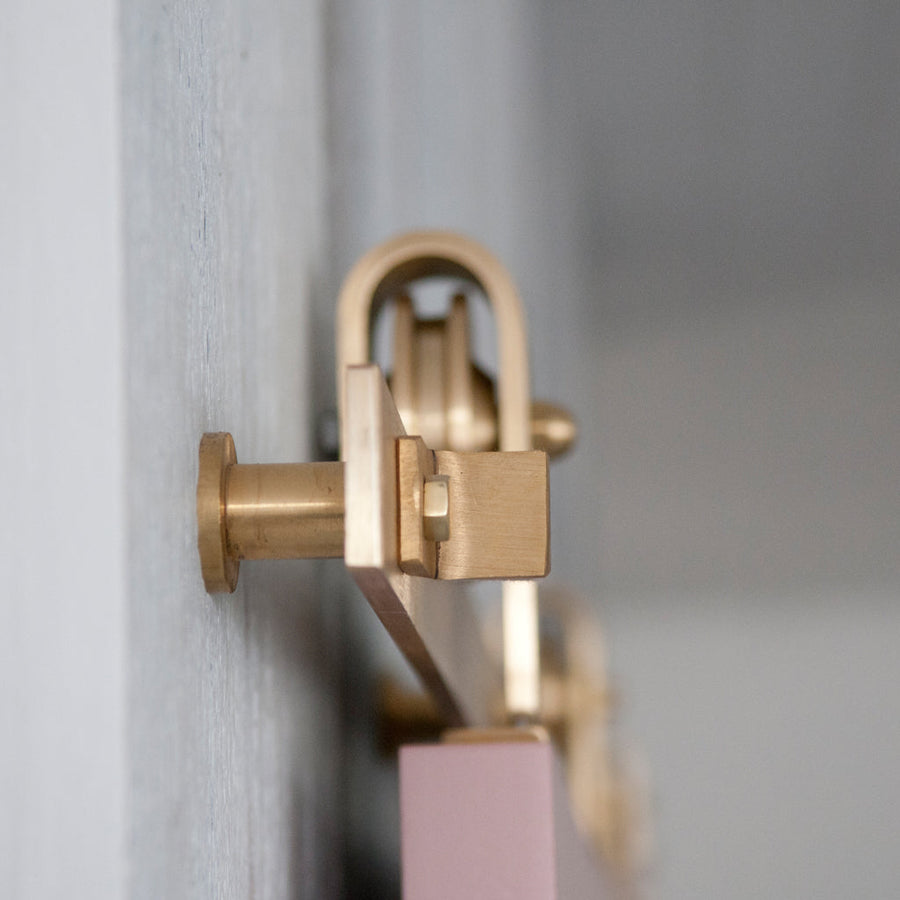
Face-mount hangers fix to the front face of the door, with the strap sitting visibly against it. This is the classic exposed-strap barn door look, where the metal is part of the design rather than hidden. It suits solid doors of almost any construction, because the fixing goes into the face where there is material to hold it.
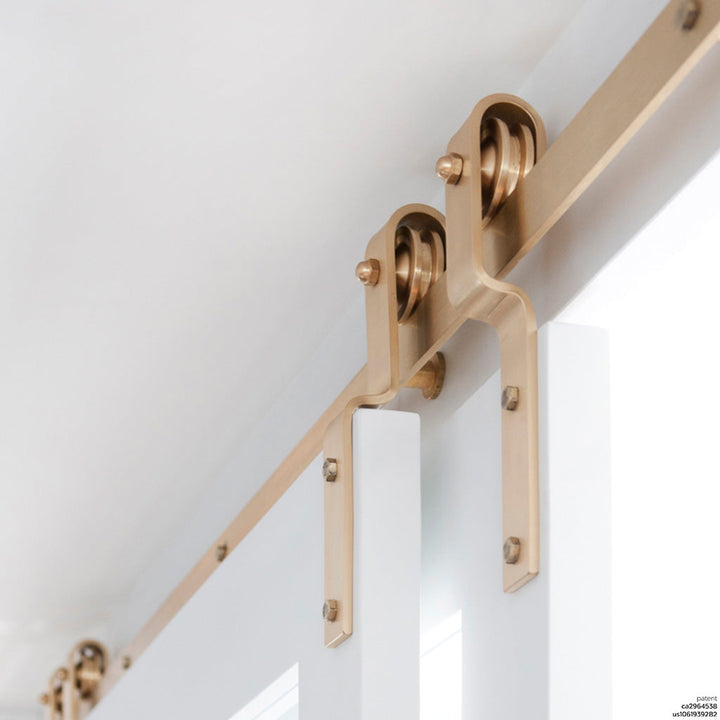
Top-mount hangers fix to the top edge of the door, so the strap is concealed and only the wheel shows on the track. The result is a cleaner, more minimal line, with the door reading as a plain slab and the hardware reduced to the roller above it. A top mount needs enough solid material along the door's top edge to take the fixing, so it pairs best with a solid-core or solid-timber door rather than a hollow-core one.
Both mounts carry the door the same way and run on the same track, so the choice is largely aesthetic. On the catalogue, each mount type is listed as its own product, so you select it up front rather than converting later.


How do I measure for a barn door, and what track length do I need?
Two rules cover most installations.
Door size. Make the door 2 to 3 inches wider than the opening on each side, so it overlaps the frame and fully covers the gap, and about 1 inch taller at the top. For a 32-inch opening, that works out to roughly a 36 to 38 inch wide door. The overlap is what gives a barn door its coverage, since it hangs in front of the wall rather than sealing into a frame.
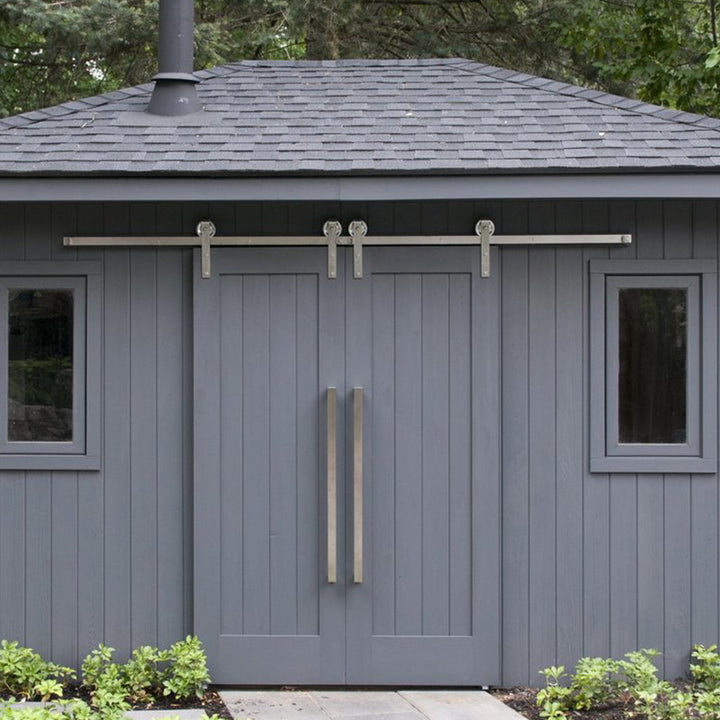
Track length. Allow about twice the door width, so the door can slide completely clear of the opening. A 36-inch door needs about a 6-foot (72-inch) track. Our tracks are 6 feet (72 inches), which suits a single door up to about 36 inches wide over an opening up to roughly 32 inches.
One measurement people forget is the wall itself. You need clear wall beside the opening, at least as wide as the door, for the door to slide onto. If a light switch, a return wall, or a window sits inside that zone, the door will not open fully, and that is the moment to consider a double-door configuration instead.
What are my options for a wide or double-door opening?
When an opening is too wide for a single door, or when there is not enough clear wall to one side, two approaches solve it.
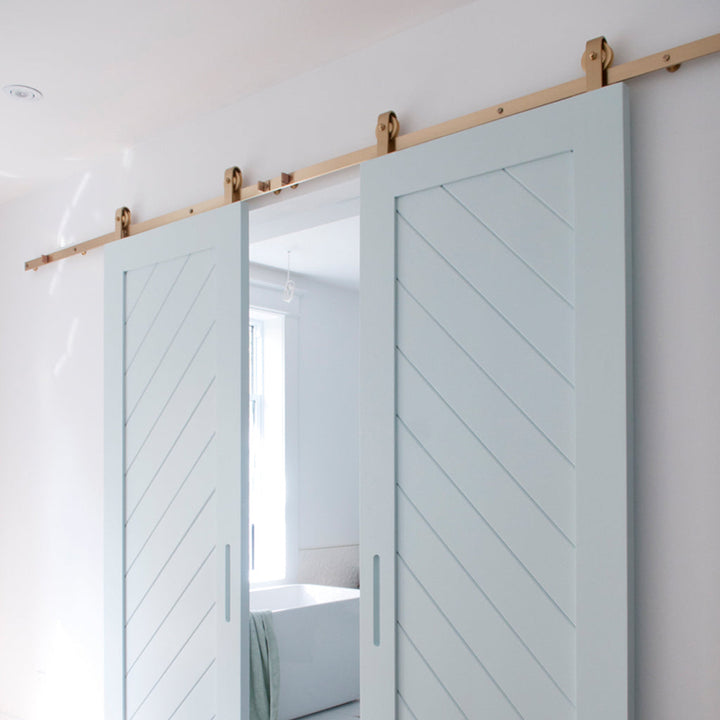
Bi-part. Two doors run on one track, meet in the middle, and slide apart to either side. This suits a wide, symmetrical opening you want to open from the centre, and it halves the amount of clear wall you need on each side, since each leaf only travels half the distance.
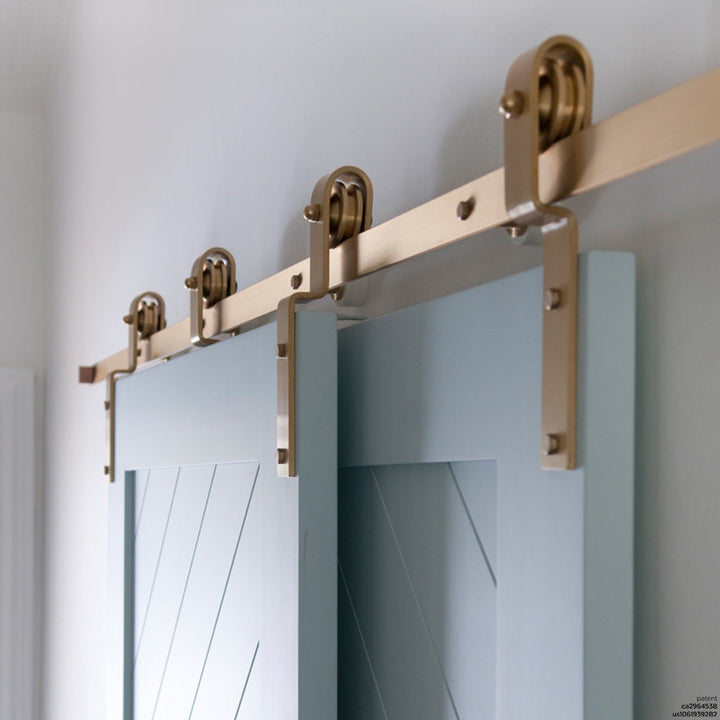
Bypass. Two or more doors run on parallel tracks and slide past one another, stacking to one or both sides. Bypass is the answer when there is not enough wall beside the opening for a door to slide fully clear, because the panels overlap rather than needing their own dedicated wall space. A telescopic bypass moves several panels per side for the widest openings.
Sizing for a double opening depends on the exact dimensions, the number of leaves, and how much overlap you want, so it is worth sending measurements rather than estimating. Send the opening width, the ceiling height, and the clear wall on each side, and the specification team will confirm the configuration and track.
Should I choose pre-drilled or drilled-on-site straps?
Pre-drilled straps arrive with the mounting holes already set to a standard door, ready to install. This is the simplest choice for a standard door and the one most projects want.
Not-pre-drilled straps leave hole placement to your installer. This suits non-standard door thicknesses, custom hardware positioning, or a builder who wants to set the holes precisely on site. If you are unsure, pre-drilled covers most standard doors.
What else does a complete barn door installation need?
Track and hangers carry the door, but a complete installation usually calls for two more things.
A floor guide at the base of the door keeps it from swinging away from the wall as it slides. Without one, the bottom of the door drifts and can knock the wall or catch the trim.
Solid fixing into the wall is what carries the weight. The track mounts into studs, or into a backer board that spans the studs and distributes the load. A barn door and its hardware are heavy, and the fixing has to be sized to the door's weight rather than just screwed into drywall.
Each product page lists what is included and the weight the system supports. If you tell us the door's weight and construction, we will confirm the hardware suits before you order.
Will a barn door give me privacy and block sound?
This is the honest limitation of the format. A sliding barn door hangs just off the wall and does not seal against a frame the way a hinged door does. A small gap remains around the perimeter, so some light and sound will pass. For most rooms, a bedroom, an office, a pantry, a laundry, that is a fair trade for the look and the floor space a swing door would otherwise consume.
Where full privacy or sound isolation matters, a bathroom being the obvious case, plan for it deliberately. Oversizing the door for more overlap helps at the edges, and in some layouts a pocket or frameless glass system is the better answer. If sound and privacy are priorities, ask us before you commit to a barn door and we will talk through the alternatives.
What materials does Casson barn door hardware come in?
Casson barn door hardware is offered in solid brass, solid stainless steel, and blackened steel. The distinction worth understanding is solid versus plated. Solid brass and solid stainless are the material all the way through, not a thin coating over a cheaper base metal, so they wear and age as solid metal rather than chipping or flaking at the edges where a plated finish eventually fails. Blackened steel is a treated steel finish with its own character.
Solid brass is the choice when you want warmth and a finish that develops over time. Like other living finishes, unlacquered brass deepens with handling and age rather than staying static. If that appeals, our guide to living finishes covers how it changes and how to care for it. Solid stainless is the choice for durability and a cooler, more neutral tone, and it holds up in demanding or humid environments; our note on the story of stainless steel explains why. Material availability is confirmed on each product page.
Where to start
If you know your opening and your door, the fastest path is to browse the barn door hardware collection, choose your mount type and material, and check the included components and weight rating on the product page. If the opening is wide, non-standard, or short on clear wall, send your measurements and we will confirm the configuration first. Registered architects, designers, and builders can also access trade pricing and whole-project specification support through the Trade Program.
Leave a comment